
Children and adults
Atypical swallowing.
-
«Hello, the dentist has suggested an assessment of my son's tongue position. He doesn't have any speech difficulties, but the dentist thinks it might be worth looking into. Could we book an appointment?»
-
«We've just had the braces fitted. Now he's struggling with his articulation and keeps slipping his tongue underneath them. What can we do?»
-
«When she swallows I can hear a noise, and I can see her tongue poking out. The dentist says she needs some exercises. Could we book an appointment?»
More often than not, the first contact begins like this.
Why it happens
What I work on.
We swallow hundreds of times a day, almost always without thinking about it. When the tongue does so in the wrong position, that small, repeated movement can shape the way the mouth develops.
-
Atypical swallowing
Instead of rising towards the palate, the tongue pushes forward against the teeth, or out to the side.
-
Tongue posture
Even at rest, the tongue has a correct position of its own. When it habitually sits low or forward instead, it affects how the mouth and the face grow.
-
After a frenectomy or braces
People sometimes come here after a short tongue-tie has been released, or during orthodontic treatment.
-
Working with the orthodontist
This is the area where working hand in hand is closest of all: the orthodontist looks after the anatomy, I look after the function.
How the assessment works.
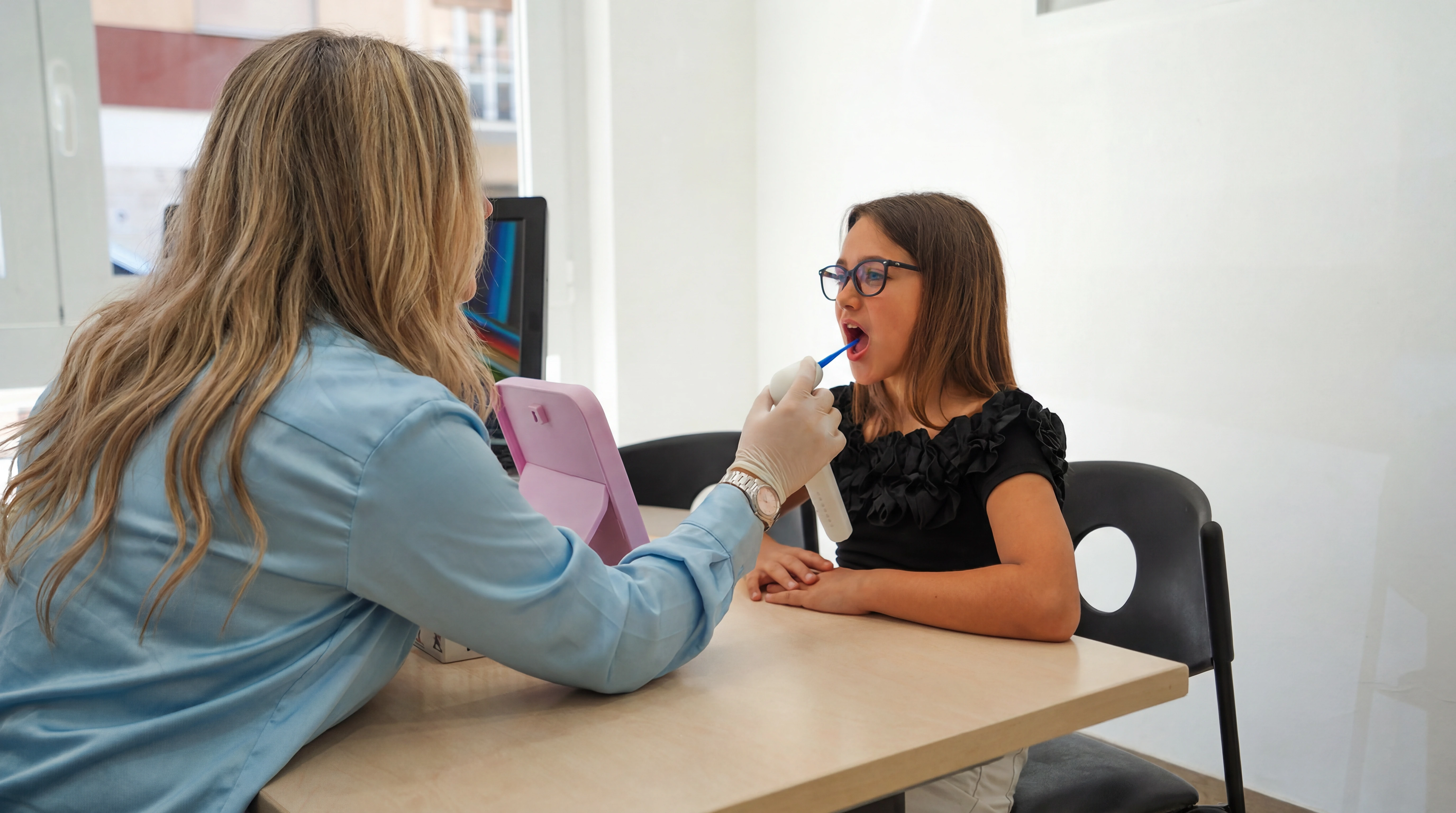
We start with an assessment of swallowing and tongue posture, to understand where the imbalance comes from and how to address it.
-
First contact
Often it's the dentist or orthodontist who first notices how the tongue pushes, and points you here. That's where we begin.
-
A shared assessment
I observe closely, with a clinical examination, over one or more sessions. I look at tongue posture, myofunctional balance and speech articulation, and I carry out an assessment of swallowing. You're part of the process, not a bystander.
-
Feedback
I explain what I've seen in clear words, without jargon. No labels thrown around: just an honest picture and what we can do with it.
-
A tailored course of therapy
If a course of therapy is needed, we build it around the person, with shared goals that we review as we go. Never a package decided in advance.
For swallowing, the assessment is usually wrapped up in a single session. From there we work out together whether and how to carry on.

An image I often use
Braces sort out the anatomy.
The tongue, the physiology.
When a child has braces fitted, the dentist works on the anatomy: the teeth straighten, the palate widens, the arch changes shape. It's good work, and often necessary.
But the tongue is a muscle, and like any muscle it has its habits. If it has learnt to push in the wrong place, it carries on doing so, even with the braces in. And once the braces come off, that movement, repeated hundreds of times a day, can shift the teeth out of place again.
That's why the work is done hand in hand: the dentist on the anatomy, me on the physiology. It's when the two come together that the results last.
When an assessment makes sense.
Sometimes it's the orthodontist who points you here.
Other times it's small everyday signs, easy to miss.

- The orthodontist or dentist has recommended working on the tongue
- They often keep their mouth open, even at rest or while sleeping
- You can see the tongue pushing forward while they swallow or speak
- After braces, the teeth tend to drift back out of place

Where it comes from
The causes that come first.
By around the age of six, a child's swallow should mature into the adult pattern: the tip of the tongue rests just behind the upper front teeth, on the ridge of the palate, and from there the swallow flows in balance, without pressing on the teeth.
When this shift doesn't happen, there's usually more than one cause behind it. Enlarged adenoids or tonsils, respiratory allergies that force mouth breathing, habits such as prolonged dummy use or thumb-sucking in early childhood. The tongue settles into the wrong position, and then it won't let go of it.
A good assessment looks for these causes and sets them in order. Sometimes, alongside my own work, it helps to consult the ENT specialist or the allergist.

Even when it isn't about speech
When the tongue affects speech.
Dysfunctional swallowing sometimes brings with it small side effects on speech: a slightly lisping pronunciation, a tongue that shows too much while talking, articulation that becomes harder once braces are in.
They're small signs, usually, but for a child they can weigh on how they get on with their classmates. That's why, when I work on the swallow, I always keep an eye on how the child speaks and how they feel when speaking too.
How long a course of therapy lasts.
I don't work with set packages of sessions decided in advance, and you won't find a price list on this site. How long it takes depends on the person and on the goals we set together: an assessment can be wrapped up in a single session, while a course of therapy might last a few months or support a child's development over a longer period. No two journeys are the same, and we fine-tune ours as we go.
What we can do, as adults.
Dysfunctional swallowing doesn't put itself right with time. It needs a focused programme, short in duration and specific in its goals, carried out in constant dialogue with the dentist or the orthodontist. When the two professionals talk to each other, the child makes one journey instead of two.