What Is Children's Speech Therapy?
 8 min read
 Speech and language therapy is not a phrase you come across by chance. Most parents hear it for the first time from their paediatrician, from their child's teachers, or by typing it into Google after noticing something about their child. Let me put it plainly from the start: speech and language therapy is about everything to do with communicating, and with children that means language, voice, swallowing and learning at school. That is all. And all of it forms one continuous piece of work, shaped around the child in front of me.
Who the speech and language therapist is, and what they actually do.
The speech and language therapist is a recognised healthcare professional. In Italy you qualify through a three-year degree in Speech and Language Therapy within a Faculty of Medicine, registration with the TSRM-PSTRP professional register is compulsory in order to practise, and ongoing professional development is regulated by law. They are not a coach, not a diction teacher, not an assistant to the public-service therapist: it is a clinical role with its own clearly defined remit.
What they do, in practice, is simple to say and less simple to do. They observe how a person communicates, identify their strengths and difficulties, suggest a course of therapy when it is needed, and work with concrete tools shaped around the person. With children, the way they communicate means speaking, understanding, reading, writing, swallowing, managing the voice. All things that seem automatic, and that in reality rest on complex neurological and muscular processes.
The four areas of work in childhood.
At the practice I work across four main areas. Each child usually comes in for just one, but the areas often overlap: a child who had difficulties with their sounds early on may go on to struggle with learning to read, and a child with dysfunctional swallowing may also show altered pronunciation. That is why I never work in separate compartments.
- Language disorders: delays in words appearing, sounds that are missing or substituted, difficulty building sentences, stammering. It is the most visible area from the outside, and the one parents get in touch about most often.
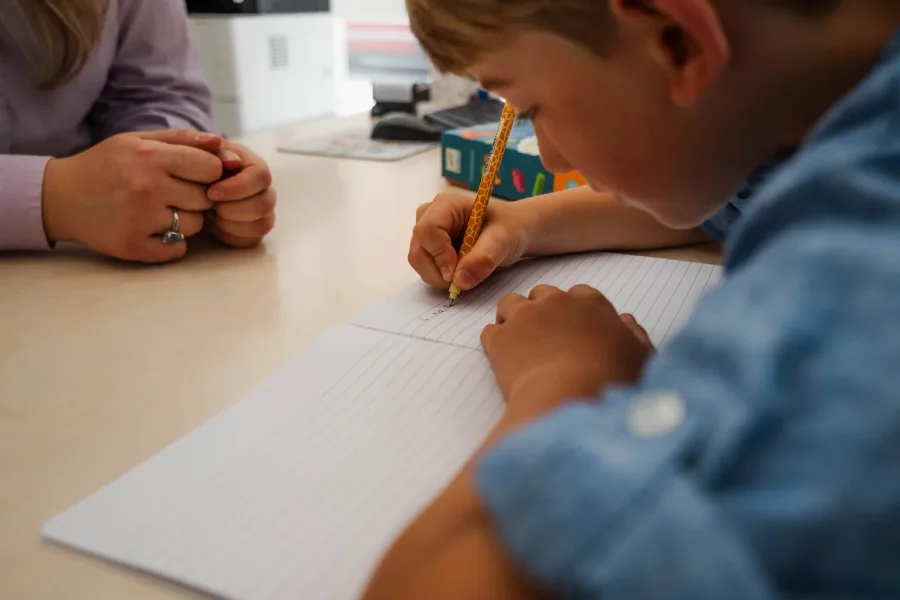
- Specific learning disorders (SLD): dyslexia, dysgraphia, dysorthographia, dyscalculia. They show up when a child, bright and capable, struggles out of all proportion with reading, writing or maths. They need to be assessed by a team, and the speech and language therapist is one of the key figures along the way.
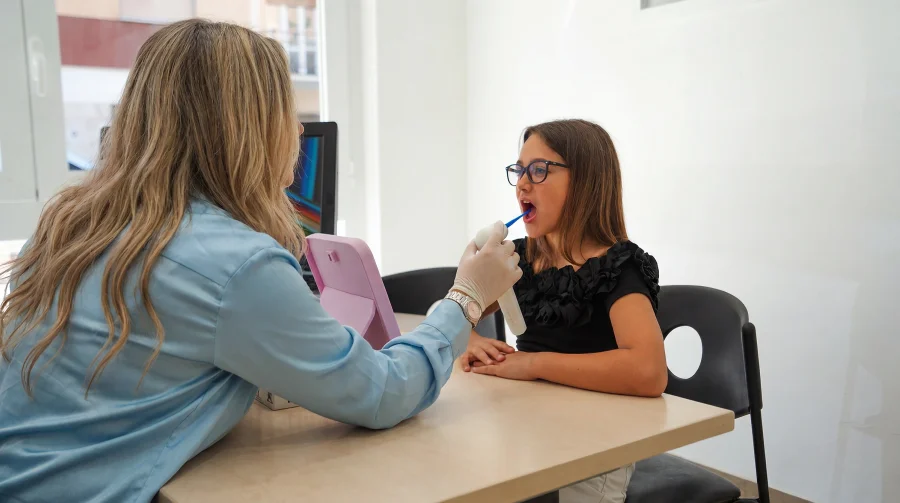
- Dysfunctional swallowing: when, in swallowing, the tongue pushes against the teeth or sits low at rest. The work is often done alongside the orthodontist: the brace sorts out the anatomy, the therapist the physiology of the tongue.
- Voice disorders: a hoarse, weakened, effortful voice. It affects children too, especially those who use their voice very intensely. It is worked on with techniques for posture, breathing, proprioception and breath-voice coordination.
Each area is explored in more depth on its own page of the site: if you want to see how a specific course of therapy works, you will find the full picture there.
How a course of therapy works, from start to finish.
A course of speech and language therapy is not a straight line with a fixed point of arrival. It is a journey that gets adjusted as you go, in which parents take an active part rather than watching from the sidelines. I divide it into three phases that recur over time, sometimes more than once.
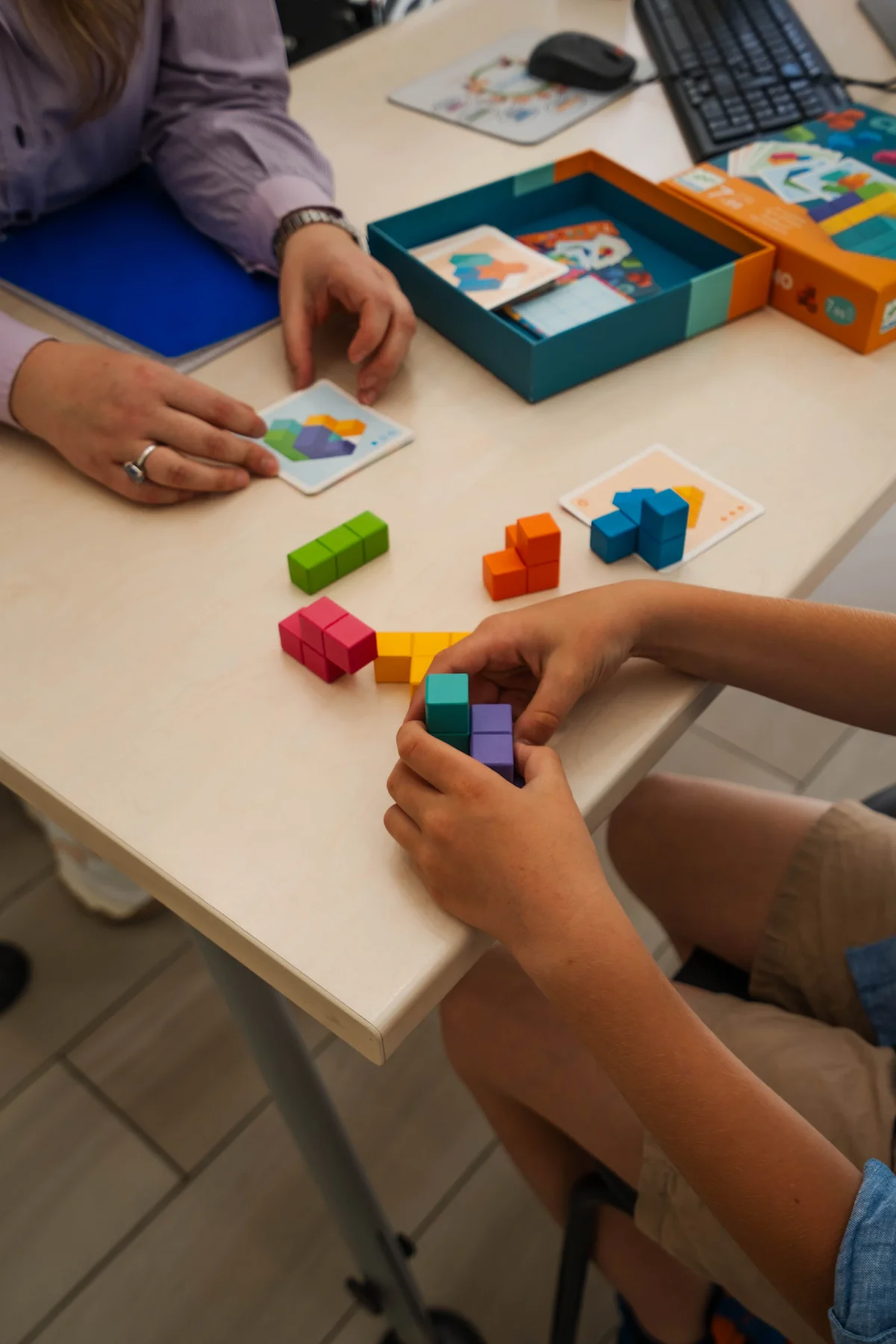
- Initial assessment: one or more sessions of case history, observation and standardised tests. It serves to build a clear snapshot of where the child is today, and to decide whether it makes sense to set up training or whether monitoring is enough.
- Therapy sessions: regular sessions with shared goals. The frequency depends on the picture: usually once or twice a week, with the length varying according to the area and the age. I keep parents updated throughout and, at certain stages, I set short activities to do at home.
- Final assessment and monitoring: at the end of the course of therapy I repeat the initial tests to measure progress objectively, and where appropriate we agree on a follow-up later on to consolidate the results over time.
Public and private: how to find your way without wasting money.
The public service (ASL, TSRMEE) provides free care but has waiting lists that, in the Tuscia area as across the whole of Italy, can run to more than six months. A private practice does not replace the public service, and it is not "better" or "worse" in absolute terms: it has a different remit. It lets you start sooner, tailor the frequency more closely, and stay in constant contact with the family. Every situation is weighed up for what it is.
A practical piece of advice I give parents: when a child is on the ASL waiting list, private work can carry you through the wait and get the basic activities under way, and when the public turn comes round the two paths can talk to each other (always with the family's consent). It is not a matter of choosing one or the other, but of building the combination that makes sense for that child at that moment.
The network around the child.
Let's go beyond the narrow, limiting idea of the one-off session. It is a phrase I use a lot, and I use it because the work of a speech and language therapist does not end at the practice. The child lives at school, in the family, alongside other professionals who support them on other fronts. Holding these threads together is part of the work, not an extra.
Anchored to my practice there is a real network: orthodontists, child neuropsychiatrists, paediatricians, orthoptists, cognitive-behavioural psychologists, SLD tutors, schools across the Tuscia area. When a child comes in, if other figures are needed, we bring them on board. When children are referred to me by another professional, I always give something back in return. This is what I mean by accompanying: taking a family by the hand and walking together, not just treating a difficulty.