Tongue Thrust, Swallowing & Braces
 7 min read
 Almost every child who comes to me for dysfunctional swallowing has been to the orthodontist first. It is the orthodontist who notices, before anyone else, that something is not quite right: the tongue pushes against the teeth during swallowing, and braces alone are not enough to correct what is taking shape. At that point, the orthodontic work and the speech and language therapy often need to go forward together.
What dysfunctional swallowing actually is.
When we swallow, the tongue should rest against the palate, start from the front and guide the bolus back towards the throat. In children with dysfunctional swallowing this movement is different: the tongue moves forward, pushes between the teeth or against the dental arches, and sometimes slips right under the front teeth. It does this thousands of times a day, because we swallow constantly, even without noticing.
The point is not the single push, it is the frequency. If the tongue pushes against the teeth for years, the pressure changes the shape of the arch, moves the teeth and alters the bite. That is exactly what the orthodontist is trying to correct with the braces. But if the cause stays active while the orthodontist works on it, the work takes longer or simply does not hold.
- Forward tongue thrust: the tongue moves forward against the upper front teeth during swallowing.
- Lateral thrust: less common, the tongue slips between the side teeth, usually favouring one side.
- Low resting tongue position: even when not swallowing, the child keeps the tongue on the floor of the mouth rather than against the palate.
- Habitually open mouth: often linked to mouth breathing, a dry throat in the morning and disturbed sleep.
- Effects on the teeth: open bite (front teeth that do not meet), crossbite, a narrow palate, asymmetries.
When the braces arrive before we do.
The orthodontist sees the tongue at work as early as the first appointment. If the child shows an obvious tongue thrust during the assessment, the orthodontist usually calls me even before starting the work. Other times the braces have been in for months, the child struggles to close the mouth, and it becomes clear that the orthodontist cannot get to the result alone. In both cases I get the call, because the orthodontist knows that without the tongue repositioned the braces are working uphill.
When a child comes to the practice already wearing braces, the first thing I do is work out where the child is at that moment: is there any discomfort? Can they close the mouth properly? Have they learnt to hold the tongue up, or do they keep pushing it down? From there I build the path, calibrated to where the child actually is.
How tongue posture is retrained.
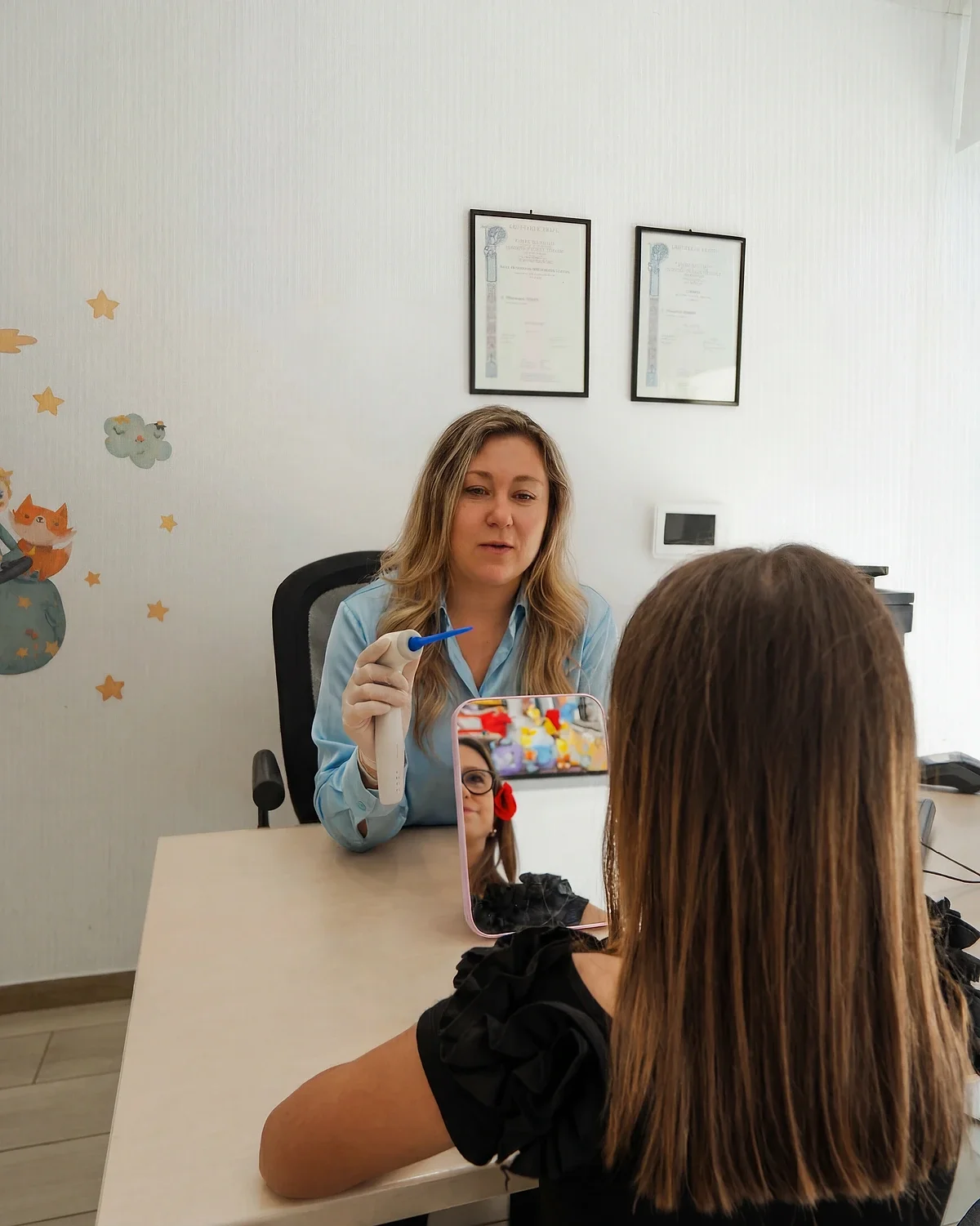
Speech and language work on dysfunctional swallowing is not a mechanical exercise, it is a retraining of the movement itself. The tongue is a muscle, and like every muscle it gets used to a position: changing it takes repetition, awareness and time. The child first has to feel where the tongue is now, then feel where it should be, then learn to bring it there while swallowing, and finally to keep it there without even thinking about it.
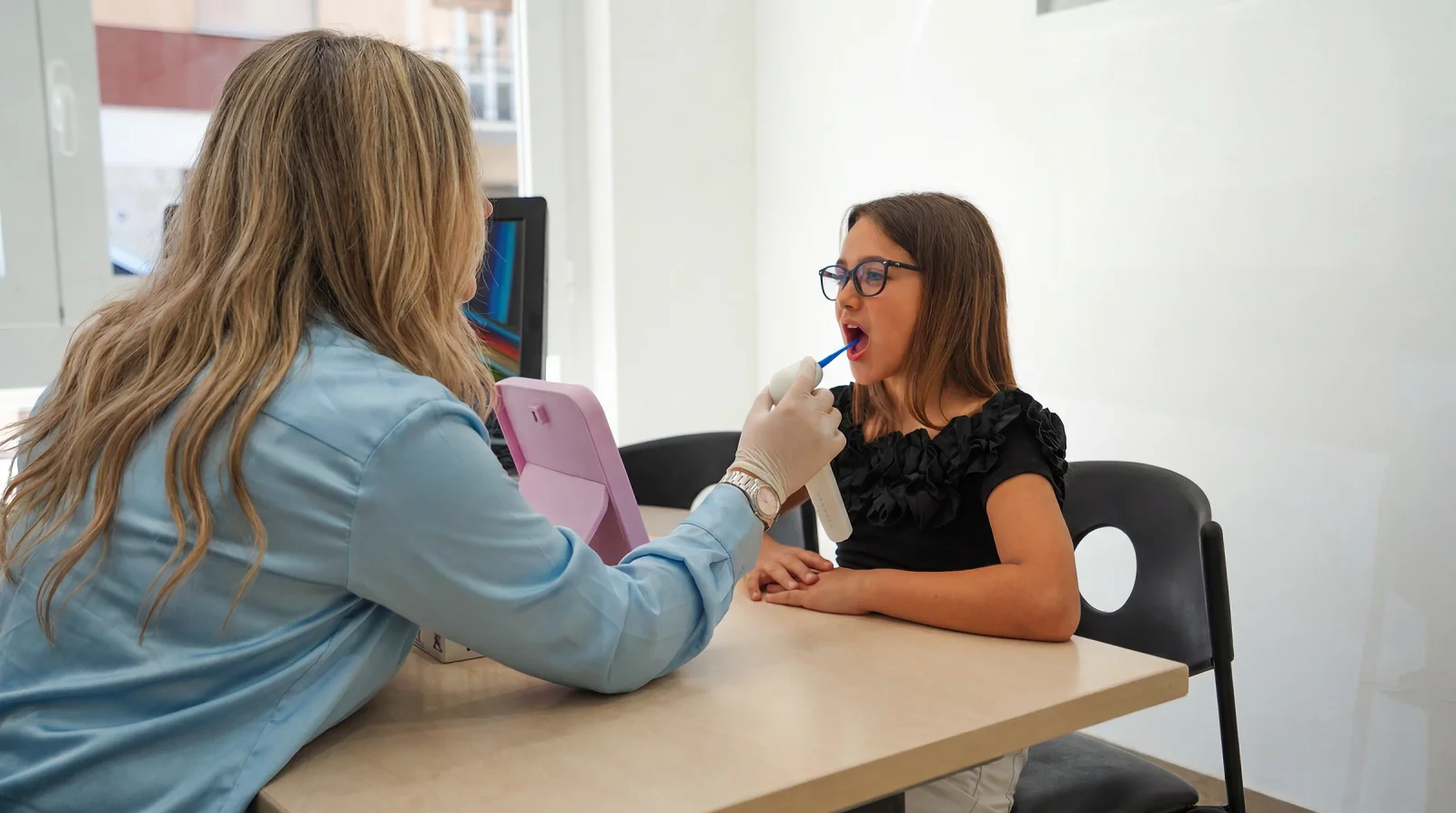
In the practice I use simple tools: the mirror to see the movement, exercises that teach the tip of the tongue to lift up to the palate, oral awareness activities, guided swallowing with liquids, soft foods and solids. At home we set a short routine, ten minutes once a day. The hard part is not the exercise: it is the consistency week after week.
Working with the orthodontist: how it really works.
We do not just talk at the start. We stay in touch throughout the whole path: the orthodontist updates me on how the teeth are moving, and I report back on how tongue posture and swallowing are coming along. We often coordinate on timing: some exercises become more effective once the braces have already widened the palate, while others need to be done first, to prepare the mouth for the work. They are two paths walking alongside the same child, and they work when they talk to each other.
It happens in adults too: people who wore braces as children, then in adulthood discover that the bite has shifted out of place again, or that they have postural asymmetries, jaw pain, headaches, neck problems. Almost always, at the root of it, there is a dysfunctional swallow that was never addressed. The speech and language work is effective in adults as well, it just takes more time, because the movement has been ingrained for decades.